

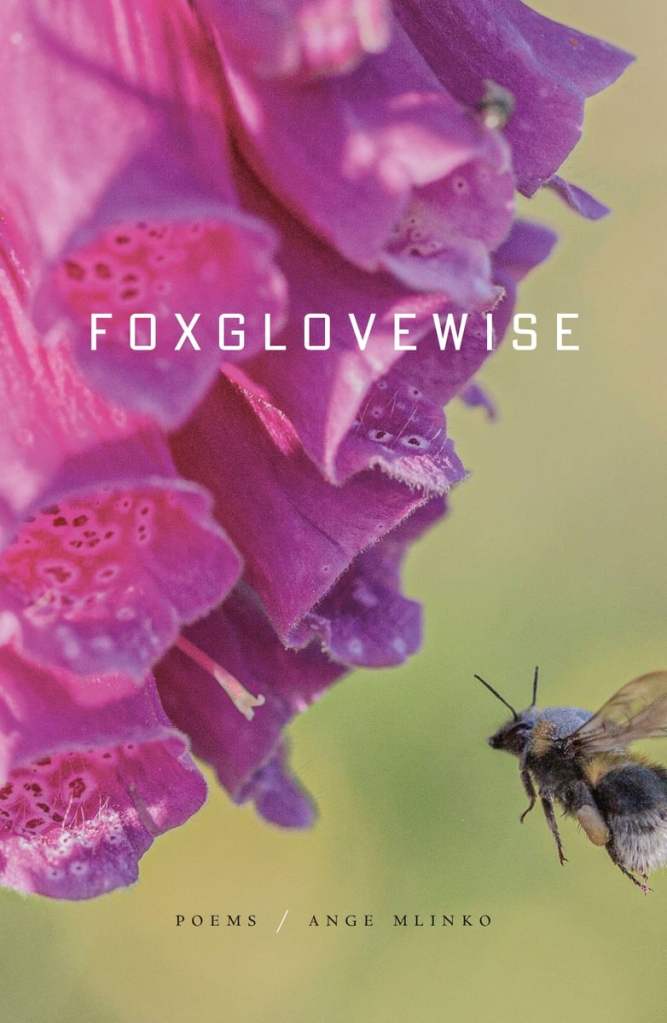
Ange Mlinko’s Foxglovewise is the haunting, painful examination of the loss of one’s parents. Rituals — spiritual and otherwise — become an integral part of Mlinko’s examination of grief, loss, and acceptance. Mlinko’s reliance on a variety of poetic forms facilitates the speaker’s deeply personal introspection about life, death, and the natural cycles defining their life. Each of the poems, however, serves as a reckoning with life’s chaotic moments. Every poem is a map entirely its own, attempting to lead the audience with wit, energy, and beauty to some sense of understanding, despite the lack of fixed points and coordinates.
Initially, one of the collection’s most powerful poems is “The Iliad in a Scottish Cemetery.” The poem depicts a scene in a burial ground, and throughout the poem, the imagery works to show the delicate balance between life and death. A culinary garden on the grounds “raises a few eyebrows, but not the dead.” Lovage, chamomile, and pineapple sage populate the garden. The speaker, however, disconnects from the setting: “On my headphones, though, is The Iliad / so my eyes take in Prestons, Grays, and Grahams / as my ears do Agamemnon, Calchas, Diomedes.” These quiet, subtle details generate a stark juxtaposition: two distinct cultures rub against one another, and the speaker is the conduit. The cultural and linguistic juxtaposition deepens as the poem continues: “Names don’t translate: a mouth of pebbles, / they slow the language roaring down the page.” The verb “slow,” with its proximity to the verb “roaring,” generates a strange, linguistic, and sensual tachysensia. The speaker’s sense of cultural, linguistic, and personal displacement culminates as the poem concludes:
I’m in two foreign countries at once, by turn
testing on my tongue the umami of these wounds,
iron-laced water like blood-anointed spear tips
and the tangy granite in the skirling burn.
The rhyming of “turn” and “burn” produces an emotional solidity and practical grounding, acting as fixed linguistic coordinates for both the poem and the speaker.
Natural imagery is paramount to the success of Mlinko’s poems, and “The Rain Trees” is a testament to the sensational and emotional power natural imagery generates in Foxglovewise. Direct and implied allusions to Keats and Heaney also add a touch of philosophical, even Romantic, nostalgia to the poem. More significantly, nature acts as a source of personal reflection amid despair and grief. The rain trees, too, represent a distinct barrier between humanity and the natural world, described as not “classed / with myths we preach / of either the Idyll or the Fall.” Thus, nature possesses an autonomy, and the speaker acknowledges the importance of its signs about the future: “as Heaney with his rain stick knew. / Rain everywhere is heaven-sent / but rain trees portend dry months here.” The rain trees act as a kind of natural prophet whose prophesies should not be ignored. Nonetheless, it is the poem’s final stanza, with its philosophical pondering about the fine thread separating grief and acceptance, that truly captures the poem’s essence: “Can rain trees slake a parti pris / for elegy, for rain’s right clink, and claim spring’s shade?” With the rhetorical conclusion, readers pause, and the question constructs a suspended space mirroring the spaces within the poem in which the natural world and humanity coexist and intersect.
“Radishes” is a poem reminiscent of Seamus Heaney’s “Dig.” With an initial reading, the radish may simply be a vegetable, a childhood food staple, a catalyst for memory. It is, nonetheless, Mlinko’s astute description of the radishes that elevates their significance and incorporation to more than a mere, superficial prop. In the first stanza, the radishes are almost a holy, sanctified entity, housed on “a kitchen table’s crude altar.” In the second stanza, they receive practical attention as a food staple, eaten whole with salt or trimmed by a knife. Still, the description’s beauty lies in that the act of consuming the radish seems as revered as taking holy communion.
The speaker personifies the radishes in the third stanza: “Radishes of rosy cheeks, of snow, / peppery radishes of yesteryear.” The radishes become a means of nostalgia as the speaker reflects, “why are you so much milder now? You don’t set the mouth on fire.” This is a pivotal point in the poem. It becomes not a poem about radishes, but a poem about aging and change, and in the fourth stanza, the speaker poses the question “Did something in your cultivation change, / or does sensation wane with age?” Then, the poem turns existential as the speaker contemplates how “Best is raw: it’s ‘war’ backward, like a spell.” The concluding lines echo the speaker’s contemplations of life’s cycles in other poems:
grown in the cold ground, color
of rose and snow—good to gnaw
a vegetable so filial and feral
late in the year, when the knife is duller.
These lines seize a philosophical moment by circling back to the radishes’ description earlier in the poem. They create an inescapability, a constant return to a single point, that reinforces the poem’s existential tone.
Foxglovewise, with its allusions to well-known writers, artists, and musicians — as well as its reliance on formal poetic forms — is a poetry collection for old souls grappling with the modern world’s demands and trappings. Simultaneously, its verses are quiet, meditative spaces where loss, grief, acceptance, and the natural world collide. Mlinko’s poems are intelligently sensual — and just as unforgettable.
POETRY
Foxglovewise
By Ange Mlinko
Farrar, Straus and Giroux
Published January 28, 2025
Paperback January 06, 2026


